
What is CBB?
Community-Based Block (CBB) Program
- A 2-year, 60-unit intensive professional counselor preparation program that meets all of the requirements for the Master of Science in Counseling, plus up to 15 additional units for the Multicultural Community Counseling specialization
- Designed to provide learners with the education and experience necessary to prepare for LPCC (Licensed Professional Clinical Counselor) licensure, as well as doctoral studies in counseling and education
- Also intended for persons who want to increase their understanding of human behavior, multicultural issues and interpersonal skills — especially those working or planning to work in counseling positions that may not require specific licensure or state credentials
Many CBB graduates have also used this degree to qualify for student services positions in community colleges and universities.
The program is called “community-based” because it has always been held off campus, in the heart of two of San Diego's multiethnic neighborhoods and because it creates a learning community in which a team of faculty and a carefully selected group of students “partner” in the learning process, each cohort of students helping to structure its learning experience. It is a “block” program because all classes are required of all students, who stay together as a group (or “block) for the entire year.
The CBB program seeks to develop the counseling skills of relationship building, process and therapeutic intervention; the academic skills of critical thinking, systematic inquiry, program evaluation and effective written and oral communication; and the personal growth experiences necessary to enable graduates to use their skills for the benefit of clients. The CBB program also seeks to adapt counseling skills to meet the needs of diverse populations, thereby training truly competent multicultural counselors. The students are able to gain a unique experience of becoming counselors through live supervision at the Center for Community Counseling and Engagement in City Heights, one of the most diverse communities in San Diego. The responsibility students assume for their own education helps them develop the proficiencies they will need to become effective change agents in schools, colleges and/or social service agencies.
- Inequality continues to grow in U.S. society and is increasing societal ills, including mental health issues
- SoCAL is one of the most diverse areas in the U.S.
- Over 2 million Californians are affected by mental & emotional illness annually
- Untreated mental illness is the leading cause of disability and suicide and imposes high costs on communities
- High vacancy rate for culturally competent community-based counselors
- Under 30% of counselors are ethnically or culturally diverse or come from the marginalized communities they serve
- Build a multicultural learning community composed of highly diverse individuals — many from disadvantaged backgrounds
- Develop a healthy learning environment for all of its members, where faculty and students work as partners in the learning process
- Collaboratively develop syllabi that emerge from community needs and the tasks the community sets out to perform in the communities we serve and at field sites, including the community counseling clinic
In this context, students learn:
- Counseling and community-building skills
- Critical self-awareness
- Awareness of one’s effects on others
- Empathy
- Emotional stamina and resilience
Creating an environment very similar to what communities face: one that is filled with ambiguity, disequilibrium, tension, and conflict . . . Learning communities create an environment of love, compassion, appreciation, support and empathetic alliances.
- Sense of belonging is recognized as an important determinant of psychological and physical well-being
- Traditional counseling models train practitioners to work one-on-one with people with the idea that the individual is the locus of the problem. In CBB, we work instead within a whole social context, with a whole community, and support counselors in becoming sources of support for one another, individuals, and communities.
- Community interventions play an important role in successful mental health treatment
- Social Isolation = mental illness
- People need to learn to work together in community in order to thrive and survive
- In a cross-cultural community, people learn relational and life skills that many have never learned and participate in a social ritual
- Founded in 1973 by Dr. Dave Malcolm
- Dr. Maria Nieto Senour – 38 years of service, including program director for many years.
- Partners-in-Learning Community Pedagogy: Each One, Teach One. Si Se Puede — Yes, We Can!
- In Fall 2014, the 1-year CBB program was expanded to a 2-year program to prepare students to become Licensed Professional Clinical Counselors (LPCCs).
- See a video from our 40-Year Anniversary Celebration!
The 60-unit M.S. in Counseling
The 60-unit M.S. degree is designed to provide the student with the education and experience necessary to prepare for LPCC licensure examinations, doctoral studies, or other advanced graduate studies. It is also intended for persons who want to increase their understanding of human behavior and their interpersonal skills. This degree will also qualify graduates for student services positions in community colleges and universities. 15 additional units are required for the multicultural community counseling specialization.
Democratic Learning Community
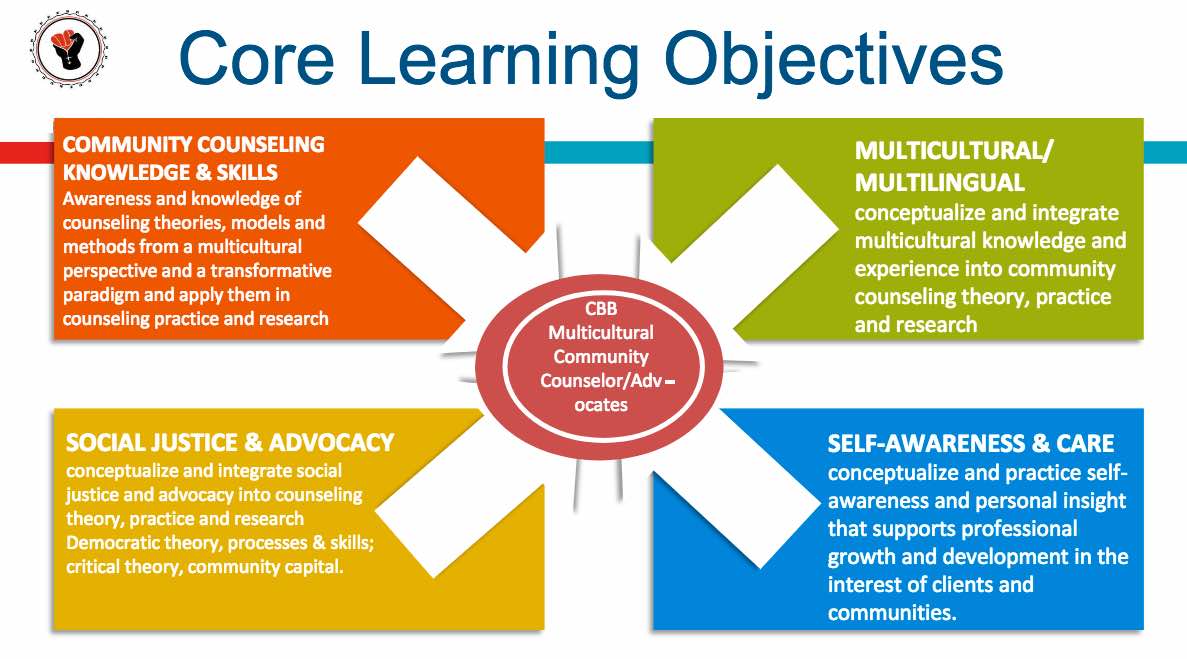
The CBB program is designed to enable each student to participate in building a learning community, where each member contributes according to their unique personal and cultural history. Program objectives include:
- To help meet the counseling needs of the growing populations of diverse groups by training students from these populations.
- To develop a baseline of cross-cultural knowledge, awareness and advocacy for each student in the program.
- To develop counseling interventions and methodologies that are culture/ life orientation appropriate for the needs of the various underrepresented populations needing to be served.
- To develop critical analyses for existing counseling theories as they apply to non-mainstream populations.
- To help place each participant into a field setting that will enhance their development, as well as use the unique skills the participant already possesses.
Our Mission
Guided by principles of social justice and community building, CBB prepares diverse, underserved students to become culturally responsive counselors/change agents and leaders.
Our Vision
To enhance quality of life for underserved individuals and communities, CBB facilitates positive social change through culturally responsive community mental health education, service, scholarship, and advocacy.