
COE Connections Episode 15: Chris Brum
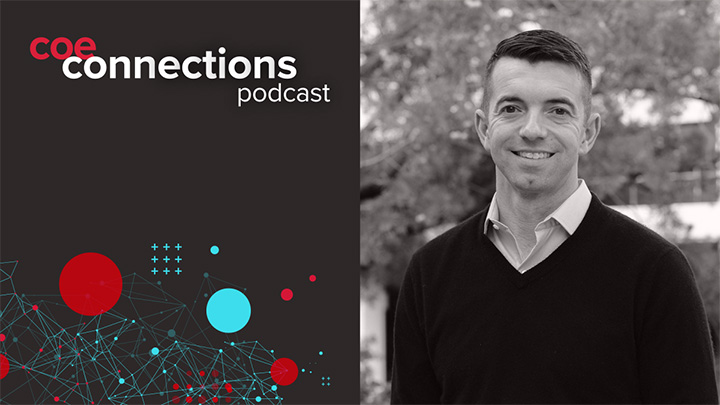
In the second episode of Season 3, Chris Brum, associate professor in the Department of Special Education and liberal studies program coordinator, discusses his passion for empowering teachers to support students with complex needs.
Listen on Soundcloud and Apple Podcasts.
Chris Brum: I try to have my work provide teachers with a lot of tools for their teacher toolkit.
Because any of us that have been in the classroom know nothing is a one-size-fits-all, and every child, regardless of disability or no disability, is so unique, and not everything works the same for every kiddo. So, I want to empower teachers to have this, and I use this analogy all the time in my classes, of like, I'm giving you a strategy to put in your teacher toolkit.
Because you might need it one day.
(Music Plays)
Rachel Haine-Schlagel: Welcome to COE Connections, the SDSU College of Education Research and Scholarship podcast series. I'm your host, Rachel Haine-Schlagel. I'm the Associate Dean for Research in the College of Education, and a Professor of Child and Family Development at San Diego State University, a Hispanic-serving institution on the land of the Kumeyaay.
Welcome to our second episode of Season 3. Today, I'm joined by Dr. Chris Brum, Associate Professor in the Department of Special Education and Director of the Liberal Studies Undergraduate Program at SDSU. Chris began his career as an inner-city special education teacher. He received both his master's degree in severe disabilities, deafblindness, and later a doctorate in curriculum and instruction from Boston College.
He completed a graduate fellowship with the Helen Keller Fellows, and a doctoral fellowship with the National Leadership Consortium on Sensory Disabilities, with a concentration in DeafBlindness.
Chris's areas of interest include communication and literacy development for complex learners, specifically related to deafblindness, autism, and low-incidence disabilities, and supporting teachers and paraprofessionals to implement high-quality and evidence-based practices.
Welcome, Chris. Thank you so much for taking the time to talk with me today.
Chris Brum: Hi, Rachel, thanks. This is my first podcast, so I'm really excited. Oh, yes, you've made the big time now.
Rachel Haine-Schlagel: Well, really excited to talk with you about your work. Okay, so I have a few questions for you today, and my first question is, why do you study what you do?
Chris Brum: Gosh, I've been thinking a lot about that recently. I think it all started in my experiences as a classroom teacher.
I'm working in Boston Public Schools. I worked as a special ed teacher, and I just noticed that there were these kiddos that I worked with that really had these complex, interesting… I found it interesting… needs, and… there weren't a lot of people around them that had the skills to support them. So kind of taking all the little pieces into play, like how they use their vision.
If they have a vision loss, how do they use what vision is remaining? What residual hearing that they might use if they have a hearing loss? You know, if their body doesn't work like a typical child's body does, you know, if they have, like, spastic cerebral palsy, what supports do they need to help them better access the classroom and their learning and instruction?
Rachel Haine-Schlagel: That's, I think, a common theme when I talk with many of our faculty are… one of the main drivers of our work is the experiences that we either have personally or that we see in our… in our work, especially working in schools.
My second question is actually a request. So, can you describe an example of the impact your research has had on the community. And you can define community however you want, just sort of something that… that you feel has really had an impact.
Chris Brum: Yeah, so my research looks at the intersection of communication and literacy. So, how do we support communication development through engaging kids in literacy?
And it, again, it stems from my time as a teacher, where working with really complex kids, that literacy was an avenue where we could make connections, where I could see that there, you know, there was an interest, and especially if we had a text of high interest.
It was a way to captivate the kids, and then be able to structure the environment to create these intentional opportunities to communicate, and then we can further develop that communication with maybe an augmentative and alternative communication system, an AAC system, or really just help the kids know or teach them that there are more formalized ways that they can get their wants and needs across.
I think the impact has been that my focus is to be able to provide strategies that teachers can use. And kind of a grab-and-go. And that's been the focus of the empirical research that I've done, and also, I just had a book published in June, and it's a… it says right in the title, you know, Practical Guide for Teachers.
And it's all about engaging kids with complex support needs in authentic, interactive reading activities. So how can they be a meaningful and active participant in literacy? And again, and I know, you know, I've been there. I, when I was teaching, this is gonna make me sound and feel really old, but back in the day, we didn't have all the commercial curricula for special ed that is available now.
So you were making it yourself, you know, you were going home and, you know, you would laminate the pages at school, and then at home you'd be velcroing and cutting and gluing and stapling, you know, and making adapted books and communication boards and all these materials to be able to use.
In class, and it was… it was taxing, and it was really difficult, because you didn't know if you were… I don't want to say doing it correctly, because you… at least I would do it, you know, thinking of the individual students, but you didn't have any guidance. So I think that's where, you know, I hope my work has had the impact of just being practical and accessible to teachers. You know, so often in academia, we do… research, and we think it's great, but even the way that we just write our papers is so inaccessible to teachers. Whether it's physical inaccessibility, where they don't have subscriptions to the journals that we publish in, or even just the formal language that we write in, you know, is so not at a level that they're going to quickly be able to digest and apply to their practice. So I really try to keep that in mind.
And also, I try to really publish in a variety of outlets. You know, I know that for us, the gold standard is peer-reviewed journals. But also, I try to publish in practitioner-focused journals, magazines for professional organizations, of book chapters, you know, and a variety of book chapters of more reference books, but also, again, those practical, hands-on materials that teachers can use to influence what they're doing in the classroom.
Rachel Haine-Schlagel: Yeah, and I, I mean, I've looked over some of the, some of your recent work, and I was really struck by how, you know, it was… there were checklists, or there were, like, actual specific activities, including, you know, steps and materials, and… and, it's such a beautiful sort of translation of what we do in academia of sort of, you know, developing that evidence base of what is best practice, what's most likely to be effective, and then also, you take that next step of saying, well, what would this actually look like with a student?
And I think that's something that's so challenging for our teachers to be able to do, is to translate what they may learn, even in professional journals and in magazines you know, if it's not sort of broken down in those steps for them, that might be a really, really challenging task. I mean, they already have challenging tasks working in the educational system today, in most… in most places. So, yeah, I really respect that about your work, and it sounds like that really did come out of your… that experience of cutting and pasting and laminating and Velcroing and all those things.
Chris Brum: Evidence-based practices are really important, and when you look at the definition of evidence-based practices, you know, they've gone through a very rigorous set of, you know, an individual practice. It has to have a very strong research base with a lot of studies that have been conducted in very specific ways, and I'm not discrediting the importance of that at all. I think they have their place, but I think we often give a lot less weight to high-quality practices, which may not have the strong empirical evidence base that something that's deemed an evidence-based practice would have, but these are things that work, that teachers know that work, and that produce outcomes for kids, so maybe they don't have as many… and you know, in my work, because it's so low incidence, I feel like we have a lot more high-quality practices and very few evidence-based practices per the definition of the number of empirical studies that were required to be conducted to kind of give it that label. But we have a lot of stuff that works, that we know works with kids. And that produce outcomes.
A colleague and I are working on a book now, and she is a recently retired classroom teacher of 30 years of experience, and she's amazing. She's one of my favorite people, Liz Casanara. This book came out of just a conversation, you know, of… the book is all about providing a framework for special ed teachers to evaluate kids with complex support needs on… for assistive technology. So, something that there's a lot of stuff out there for assistive technology, but nothing really specific for this population, you know, of kids that have a lot of stuff that needs to be looked at. You know, their vision, their hearing, their physical mobility. They might need a highly specialized wheelchair.
You know, they might need specific mounts to put different devices on. An iPad might not work for them, because the glare really imp… you know, the glass screen impacts with their vision. So how do you take all… you know, we're trying to provide a framework to support teachers to kind of capture all these details, and put them in one place, and look at them comprehensively, and say, oh, okay, now we feel like we're in a better place to make a decision on how to most effectively support this kiddo. And it came out from the field, and Liz is now working part-time supporting kiddos, and it's great because, you know, she'll kind of bring the practical piece, and I'll bring the more empirical research piece to it.
It's been so fun creating, you know, we keep looking at each other, we meet weekly, and we'll be kind of typing away on our laptops and look up on, you know, we'll be working on the same document, and we'll look up and be like, oh wow, this is pretty good. We're doing some good stuff here.
Rachel Haines-Schlagel: That's so great! What a great experience to have, that, you know, you're using all of the knowledge that you've gained and expertise that you have, and combining it with this other person who has really complementary and yet different expertise, and creating this really practical tool that teachers can use. Next question I have is, what do you struggle with the most in studying your area?
Chris Brum: It's funny, because it's what brought me into the field, is the uniqueness of the individuals can also be the most challenging. So, the uniqueness in the sense that it's really hard to do more of the sexy research that gets you bigger funding dollars. The larger end studies, because in those studies, the participants have to be much more consistent with their characteristics across one another, and that's really hard with extensive support needs, and especially with deafblindness, because the way that the characteristics of the different disabilities that the children will have manifest so differently across individual to individual, so it can be really challenging, because it's challenging to find participants, often. It's challenging to find participants that are similar enough that you can do intervention research. So that's been something that's been difficult.
I would say another aspect is just... Teachers are doing the best they can. Especially special ed teachers, you know, we have such a need for special ed teachers, so it's often adding a lot on their plates to say, hey, can we try out this new thing that I think is really gonna work with your kiddos? Because they're doing their best just to, you know, to get by.
Rachel Haine-Schlagel: I don't know if this is something that you encounter in your work, but I know in my work in the mental health field, there's a really fine line that I walk in making sure that what I'm trying to do is not suggesting that they're not already doing their best or doing a good job, but more, you know, sort of as you were talking about, tool… giving them tools to focus more easily, more, on something more intensively, or do something more consistently. I want to make sure you're empowering teachers, rather than disempowering them. And your comment about the research design as a sort of, like, almost a structural inequity to being able to conduct the research that you do is really interesting in that, you know, it's…
Sort of certain funding streams or certain types of research are not accessible to you because you focus on such a unique population, and that sounds like we have work to do as a broader field, and how do you design rigorous methods that meet those standards, that sort of take into account all these… the variability in the kids that are… that are a focus of your work.
Chris Brum: It's become, a real barrier sometimes, because, especially when you want to do work that crosses institutions, you know, that gets much more expensive. Working with colleagues at a distance, or even with I, you know, I was… had this… study that I'm hoping one day it will get funded, but, you know, it's gone four times now through different funders, and they praise the work and the structure of the research in the reviews, and then they all kind of say the same, that, but we want a larger end, we want more of an impact. You know, and it's really hard to say, yes, so do I, but it has to start somewhere.
Rachel Haine-Schlagel: My last question comes out of my own background as a clinical psychologist. I would like to… to ask clients when I… when I worked directly with clients, you know, if I could wave a magic wand and make whatever it is that you're struggling with better, what would that look like? And so, for you, I asked that question, you know, what would… what are you working towards? What would it look like if you've succeeded, if you were out of a job? What would… what would… Schooling look like for these kids?
Chris Brum: Like, if I'd met all my goals, what would be different?
Rachel Haine-Schlagel: Yeah. Yeah. Yeah. You and your colleagues, you know, your field.
Chris Brum: I think that special ed services would be delivered in a way that really supported the variety of learners to have meaningful and high-quality instruction all the time, with peers like them with disabilities and those without.
In a way that teachers were fully supported, and that classroom environments were highly engaging all the time, and really kids were learning really great stuff, consistently. Because it breaks my heart to think of it, but that's… That's often not the reality in a special education setting.
And even though we've come a long way in the United States, and I'm reminded about that with some of the international work that I do, you know, when you go to developing countries, and you look at their special ed structures and systems, and you think, oh wow, okay, so we really have come a long way. Not a lot of time, really, and just, you know. 70 years, really, but we still have a long way to go.
You know, we still have a really long way to go to really be authentically supporting our students, and there's just so many layers to that. You know, that means supporting our teachers, and providing them with the resources and funding our districts appropriately, and in a way that it's not… they're not just getting by, but they can go above and beyond. And even, you know, at the legislative level, where we still have IDEA law, special ed law, that it still says that, you know, it has to be appropriate, and I hate that word. You know, which is appropriate as just baseline. You know, it's not saying, like, really meaningful progress and engaging, and is going to help improve their quality of life.
So yeah, I think that'll be… when special ed is not seen as a place, as a negative, and more of a collection of supports and services that students can receive when they need a little more help. To access teaching and learning, and that it's something that a fluid system, where students can kind of go in and out of very easily, instead of a tracked system that kind of leads students down a completely different path, and often away from general education and the cash and prizes that you can receive after getting a high school diploma, I think then the work will be done.
Rachel Haine-Schlagel: I genuinely hope we get there for our kids' sake, for all kids' sake, and yeah, thank you for taking the time. It was really great talking with you and learning more about your work.
Chris Brum: Yeah, thanks, Rachel, thanks for having me.