COE Connections Episode 17: Alejandro Gonzalez Ojeda
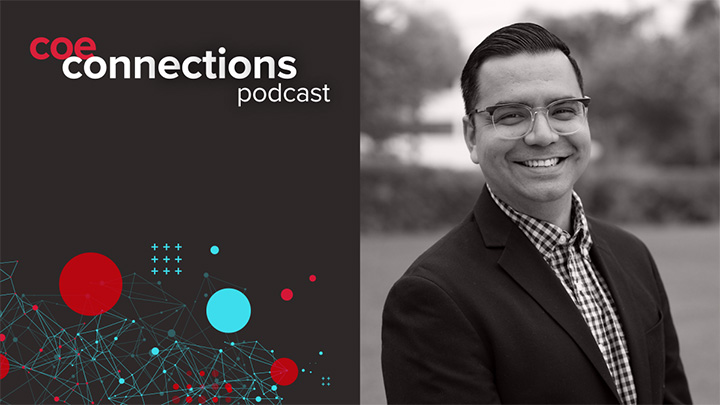
In the fourth episode of Season 3, Alejandro Gonzalez Ojeda, associate professor in the Department of Educational Leadership, discusses his work to improve school leadership preparation.
Listen on Soundcloud and Apple Podcasts.
Alejandro Gonzalez Ojeda:
We hosted an in-person PLC for the Wallace Foundation grant that we are the technical assistance providers for, and one of the things that several of the members who attended from these different universities. Hearing throughout the day, wow, thank you so much for bringing us together and being able to facilitate conversations that are deeply needed. And are rooted in being able to be honest, authentic about the issues that we are seeing in our work, and also exploring potential solutions with one another.
Having other people in academia, being able to be vulnerable like that, like, we don't know all the answers, but we appreciate being able to come together and have growth-producing conversations, honest about the things that we are dealing with. It's something that, to me, just… it just stands out and keeps motivating me in terms of bringing people together through this work, and then also highlighting the human side of leadership. Being able to acknowledge that we don't have all the answers, but we're working towards that, and the journey is a lot more valuable sometimes than just getting there.
(Music plays)
Rachel Haine-Schlagel:
Welcome to COE Connections, the SDSU College of Education Research and Scholarship podcast series. I'm your host, Rachel Haine-Schlagel. I'm the Associate Dean for Research for the College of Education and a Professor of Child and Family Development at San Diego State University, a proud Hispanic-serving institution on the land of the Kumeyaay. Today, I'm joined by Dr. Alejandro Gonzalez-Ojeda, Associate Professor in the Department of Educational Leadership at SDSU.
Alex serves as the Graduate Advisor for the Master's in Educational Leadership PK-12, and the preliminary administrative services credential programs. His research focuses on school leadership preparation, where he has worked on understanding leadership pipelines and program redesign in higher ed institutions. Alex received his doctorate from SDSU in Educational Leadership in 2018, and joined the tenure-track faculty in 2020, and he was recently promoted to Associate Professor with tenure. Congratulations! Welcome, Alex, and thank you so much for taking time to talk with me today.
Alejandro Gonzalez Ojeda:
Thank you so much for having me. I'm excited to have FOMO, Nomo in being a part of the group that has been highlighted, so thanks again for reaching out and, you know, having me kind of share a little bit about the work. It's really nice to just learn what everybody's doing and, you know, get to know, you know, what's happening at the College of Ed.
Rachel Haine-Schlagel:
Oh, well, I'm glad that you now feel included in the exclusive group that is the podcast interviewees. Okay, I have a few questions for you today, and my first question is, why do you study what you do?
Alejandro Gonzalez Ojeda:
I think part of it is really valuing mentorship. I think about when you have someone who shows an interest in your talents, in your skills, in your potential. And I think that's where leadership really has the opportunity to help others shine. And so, a lot of what I think through in publications, or service, or in teaching is how to elevate the voices and the opportunities for others.
Teaching in the master's, or the credential program, or in the doctorate work, there's so many talented people in education that I think sometimes might not get an opportunity to have their ideas come through, or their perspectives come through, and I think that's what really makes education such a wonderful place, or a wonderful field to work in. That there are all types of different perspectives around, you know, values, of backgrounds, of culture, of knowledge, of interesting things, and so for me, I think that's really what kind of motivates me, is there's always something new to learn, and there's always something that you can learn from somebody else other than yourself, or just in your silo, or just, you know, working individually, because it tends to be a little bit isolating sometimes working in academia, right, or even doing research, and so that's why I value collaboration, I value getting new ideas from colleagues, or from co-authors, and just kind of exploring different things, and… but I think it all comes back to mentorship, either mentoring someone, or even just yourself being mentored by way of connecting with others.
So, I mean, Rachel, I think about when you and I met, you know, all those years ago, on the first fall of me joining the faculty, and you reached out as a part of, you know, kind of your outreach that you do. But then just being able to connect and, like, think about research avenues and, you know, making sure that your work is in line with interest, and also kind of keeping true to what it is that drives you, versus just, you want to get tenure, or you want to get recognition or awards, but, like, really, what is it that drives you, and allowing that to kind of be the center of the work. And so, I mean, for me, that was a moment of mentorship. And something that I really kind of hold near and dear in the work that I do with the classes, or like I mentioned, in service, or even in just in publications, too.
Rachel Haine-Schlagel:
Well, I also remember very fondly our first meeting and how we… we met in person during COVID, across a table from each other at a coffee shop outside, and it was a very, unique experience at that moment. Unfortunately, more unique now than I'd like, right? We don't really get together in person as a community very much, but… Okay, so my second question is, what are you working on right now?
Alejandro Gonzalez Ojeda:
You know, it's interesting, now kind of being on this side of the tenure track, and just feeling still the drive to go, go, go, but refining, I think, a little bit more in terms of, like, well, what is something that I can leverage from, you know, the X number of years of being, you know, at the university, to really kind of refine my focus even further. And so, an area that I'm working on right now is, you mentioned around leadership preparation, particularly around what are the program managers, directors, or chairs of these leadership preparation programs doing in order to address the needs of the field of education with leadership. And so, for about, gosh, I want to say probably the last, maybe close to 5 years, our department has been very fortunate to have a relationship with Wallace, the Wallace Foundation, in supporting through a technical assistance grant that we hold and I manage, and being able to support 16 universities in total, which San Diego's one of them, in their pipeline redesign in partnership with a local district.
And so, something that's really interested me through this work is not only facilitating the PLC, the in-person, the virtual sessions, the knowledge sharing between these different universities and programs as they're working on redesigning their leadership preparation program, but more so in terms of, like, what we can learn from one another, right? And I think that's such a beautiful and powerful thing to be able to say, here are the 16 universities throughout the country, from West Coast to the East Coast to, you know, the South, the North, wherever, and you have an opportunity to say, you know, what is the context of the needs of the school districts in which you are serving. And beyond that, what are things that are common across all of our views around leadership, around serving students, serving communities, that we can learn from one another? And so, right now, what I'm working on is we're in the… like I said, we're kind of, like, getting to the sunset of that grant for these universities, and a part of my work has been to bring them together in person a couple of times, and virtual.
And being able to, again, support how it is that they are thinking through the components of their program, from recruitment, admission. Course design, assessment, candidate outcomes, and then monitoring of their progress throughout, you know, after they've left the program, and really kind of thinking around what are the decisions that you have made as a program to help improve these different components of leadership preparation? How is it that you engage with the districts? How is it that you engage within your department to really kind of determine what are the priorities around these different components? What are the things that you want leaders to walk away with and be ready on day one of stepping into either being a vice principal or being a principal, depending on on their track and their licensure at their state.
And so, that's something that I'm working on, you know, seeking insights from leaders, seeking what are some of the things that they have taken away from the PLC process that we have facilitated, and then more so, what are some of the tangible outcomes? I think that that's something that is really interesting to see from these four or five years of working on this grant with other universities within your own university as well? What are some things that you're taking away that you see as being impactful in supporting the leader development pipeline within your region? And not only within the district, because each university was paired with the district, but more so in terms of there's many districts that you serve, so how is this influencing beyond that for sustainability beyond the grant, and then also particularly impact within the region.
Rachel Haine-Schlagel:
Yeah, and definitely see as a theme as you're talking about both why you do what you do and your current work, this focus on community and focus on sort of sharing and creating… co-creating knowledge. And I think professional learning communities, or PLCs, are just a really great method for focusing on that shared generation of knowledge.
Alejandro Gonzalez Ojeda:
Well, and I don't think we don't leverage it enough, because I think that, especially in K-12 education, if you were to speak to any teacher and ask about what's your experience been with PLCs, the majority of them will be, yeah, we do it every Friday, or we do it once a month, and it's 30 minutes, or 45 minutes, or maybe even an hour, and it's either during a duty or after duty, right? And it's extra time, or compensation, whatever, but then it's infrequent, it's unstructured, it's not always, you know, with students at the center, and not all of them, but not every district or even higher institution will do PLCs in a manner that is conducive to true collaboration and driven by inquiry. A lot of times, it's more so, we're together, here are things, here's the housekeeping stuff, here's notices that we have to make sure for compliance. And then it's like, okay, now you've got 20 minutes to collaborate and address these big issues.
And so, some of the work that the team has done in these PLCs with these universities has been to really kind of indicate the value of the time together, right? And less about sit and get, and more so about collaborating, and more so about engaging in, like, how are you dealing with the communication with the districts? You know, they're complex systems, and oftentimes a lot bigger than a department within an educational leadership program. And so, how is it that you're reaching consensus around what the priorities are in leadership preparation, or how is it that you're coming to terms around the assessment of these leaders, whether it is state licensure, you know, requirements, or whether there are, like, more localized priorities within the district as well.
Rachel Haine-Schlagel:
My third question is actually a request. Can you please describe an example of the impact your research has had on the community? And you can define community however you'd like.
Alejandro Gonzalez Ojeda:
I think of impact in probably a couple of different ways, and communities as well. Our work as faculty focuses on scholarship and, service. And, and also our work around beyond just our media community. I think a lot about where my areas of work around publications, around service within or outside of the university, and then my teaching. And so, when I think about impact, for example, across the three. I think that there is definitely a through line in, you know, what motivates me, what interests me, and where I'm trying to lead some of the work and leverage it. So, for example.
In publications, or in my professional growth component of the work, I think about the dissemination some of the work that I have been able to do, particularly actually early on, when I started the university, we had a grant that was from the Stewart Foundation, and my chair and I were working on highlighting the, the need at the time. To continue to provide leader preparation experiences through the virtual format. And so, think back to early-mid 2020, and programs were adjusting, and then also in terms of how is it that you still provide clinical practice or field work to aspiring leaders who are kind of in this limbo of, wait, what is happening in the world right now? You know, with schools being, you know, accessible or not accessible, but communities still having a need?
And so, I remember talking with Doug Fisher at the time, and we had this grant from the Stewart Foundation, and the goal was to be able to identify impactful virtual experiences that still provided leadership candidates with a clinical practice. And so, the impact that I saw from that work was that we created a network, and we created a network of preparation institutions throughout California, from Southern California, the, you know, the LA area, up to Northern California as well, who were really interested in, facilitating these experiences.
And so, along with kind of this theme of, bringing people together in PLCs, that was really kind of my work. And so by the end of it, we had about 20 or so different types of artifacts that came from this experience, and I met with them routinely throughout that time in, like, 20, 21, somewhere around there, to develop these. And the impact that I would say that came from that was that those institutions were able to make a shift. Not only into virtual components of leadership preparation, but then also in their thinking. Because we brought these different institutions together, and through this network, they were able to see, oh, there's a greater need around trauma-informed leadership. There's a greater need around SEL types of preparation and the mindsets and mind frames and the practices for aspiring leaders. Or there's also a need around having virtual learning walks. You know, leaders still need to be able to see what is happening in a classroom, in a non-evaluative way, and be able to take that back for feedback to have growth-producing conversations with teachers and also with families.
And so, I think that's one of the areas of impact that I, early on, that I can reflect on, where, you know, not only did this work, influence candidates, but also kind of long-standing practices for these institutions. Another area from that that resulted, from creating these virtual experiences for leaders. Was that probably around 2022, maybe? The Center to Close the Opportunity Gap, had been, working around creating a, a clearinghouse. And in this clearinghouse, which is still up and running right now, the opportunity was to be able to house evidence-based practices that helped to close the opportunity gap for students. And one of the things that came from the Stewart work, and then also that led into the work into the CCOG, we call it, the Center to Close the Opportunity Gap, which is housed in at the CSU Long Beach, is that we were able to then say, hey, you all have these, those in the network for the Stewart Grant, you all have these, evidence-based practices that you have designed, you have implemented, and you've collected data on. Would you be willing to then share your expertise with educators beyond just this network? And so, some of them did, and as a part of the work with CCOG, we developed a vetting rubric to be able to, you know, evaluate these practices, the impact that they had in terms of candidate assessments, and those kinds of things. And so, some of them were submitted, and so now they reside within this clearinghouse.
When I think about impact, I think about dissemination. I think about how is it that we, again, kind of highlight these different experiences that are impacting communities through leadership that others are able to then kind of take on as either, like, a case study or just kind of a different perspective, be like, oh. If this is the type of trauma-informed leadership that is happening in LA, you know, LAUSC, that was a partnership that we had through that work, we serve a similar demographic in southern San Diego or in eastern San Diego, so why not take a look at this practice and see how it might benefit, you know, our leaderships or even our communities?
Rachel Haine-Schlagel:
Now I want to ask you, what do you struggle with the most in studying, what you study?
Alejandro Gonzalez Ojeda:
I think there's always the component of availability, of time, and access to people. Even though we're now really good at researching through virtual instruments, you know, interviews, focus groups, those kinds of things. I've done some of that, even throughout COVID, and now thinking about how do you continue to have the authenticity of research, through this kind of, you know, medium. So I think that's always kind of a struggle. Everybody's busy, everybody has a million things on their plate, and they've got to keep them spinning. So I think one of the things that I maybe struggle with is being able to have a refined focus when it's time for research, so that I can maximize my time, and also that of those who might be participating in the research, whether it's co-authors or even participants in a study. Because, again, I think that people's time is really valuable, and so not having a good plan in advance can really kind of set things back a little bit. I think that's probably where I would say either I take the most time in planning.
And then that might be the struggle, is to get to a point where, like, okay, I think this is… it's not a foolproof plan, but maybe there's a plan A and a plan B, and then getting to the research and the writing part of it, right? Once that's going, I think that's… then you have enough to pull from. Yeah, I would say probably the planning aspect of it, just to make sure that, you know, you cross all your T's and dot all your I's, and making sure that, you know, is this a sound plan to move forward? Because once you get going, you can change it along the way, but then you don't want to set yourself or other people back.
Rachel Haine-Schlagel:
Yeah, as you said, time seems to be more and more scarce, and so trying to be respectful of your participants' and collaborators' time, your students' time. I would imagine takes a lot of resources, especially when you're working with as many different people from as many different institutions and different time zones.
Alejandro Gonzalez Ojeda:
Oh, yeah, for sure. Yeah.
Rachel Haine-Schlagel:
So, my last question is, what would… I mean, I'll use the word society broadly, but what would your area, what would leadership preparation look like, if your work was done, if there was nothing else for you to work on?
Alejandro Gonzalez Ojeda:
You know, I think that in a world, right, where leadership is efficacious and inclusive and really puts forth valuing not only self in terms of balance, but also understanding of others. I think that leadership, all things were said and done, and we've reached that place of knowledge where… so we know better and we do better. I would think that it would look really inclusive in terms of who is at the table or who's in the room when decisions are being made about things that impact students.
And that would include a whole… You know, range of characters. You know, members of the community from the parents, from the students, from the paraprofessionals, from the teachers, from the counselors, from the site and district leadership as well. And I think that's what really, I would say, would be, the ideal state where there's representation among those that are being represented through the policies and the decisions that are made. And it would be inclusive in the matter that we are really thinking through, ultimately, what students need.
How do we make them feel like they belong, and the adults as well. I think that oftentimes we put a lot of emphasis on assessments, on metrics, and on dashboards, and all those things are very important to give us a, you know, a certain sense of the state of things, but I think leveraging, again, and highlighting the voices of those who actually help us to produce those numbers or those metrics, I think is even more important. You know, we often talk about data is a two-part story. The first part are going to… is going to be the quantitative, the numerical data, and then the second half is going to be the qualitative data. How do we explain what is happening, and how do we understand how to better address some of the common challenges or some of the issues that we're seeing.
I think, again, the voice of the members of the community, whether it's the school, the district, the region, I think those are just as important to be able to highlight. So I think leadership would essentially really look at having the time, the place, and the resources to be able to elevate those voices.
Rachel Haine-Schlagel:
Wow, that sounds like a wonderful place for us all to be at, where groups of stakeholders, different people who are all working towards the same goal can be in the room together, making decisions together. Sounds like a wonderful dream. Well, thank you so much, Alex, for talking with me. It was really, really great to hear about the work that you're doing. And the focus that you're placing on community and collaboration, you're contributing in such powerful ways to the whole educational system by focusing on the the leadership component of education. So, thank you so much.
Alejandro Gonzalez Ojeda:
Well, thank you for having me, and we'll have to catch up again and grab coffee. I don't know if we'll have Balboa Park Road to ourselves, but it'll be nice.
Rachel Haine-Schlagel:
Yeah, yeah. Well, we'll be able to sit closer than 6 feet apart from each other, so that could be nice.