In a world increasingly defined by the rapid advance of digital technology, the ability to analyze data to solve problems and make decisions has never been more important. Yet in the U.S. education system, few students are given hands-on experiences to connect data to their communities.
An interdisciplinary team of math education experts from San Diego State University’s Center for Research in Mathematics and Science Education are working to change that by bringing developmentally-appropriate and culturally-relevant data science curriculum to elementary educators in San Diego and Imperial Counties.
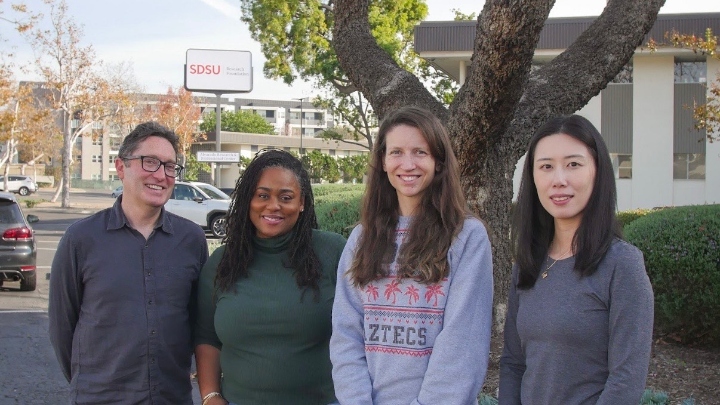
Funded by a professional development grant from the California State University, Assistant Professors Brittany L. Marshall (School of Teacher Education), Weichen Zhao (SDSU-Imperial Valley/STE) and Victoria Delaney (College of Sciences), as well as Associate Professor Nicholas Johnson (STE), are developing and recruiting for a pair of workshops for educators that will be held in the summer of 2026.
“We want to help young kids build relevance and make sense of math content through recognizing the people, the places and the things that happen around them,” explained Zhao, whose research focuses on mathematics teacher training.
The initiative, dubbed “CARPE D.I.E.M.” (Data In Elementary Mathematics), will provide three days of professional development for 25 teachers in the Imperial Valley in early June, and another three-day session for 25 San Diego-area teachers in late June. The team is eager to recruit in the borderlands, particularly in underserved districts where teacher professional development is not readily available.
The CRMSE team will begin the recruitment process in early April 2026 at both locations. Participating educators will receive $250 incentives, as well as free instructional resources and the chance to form professional learning communities with colleagues.
"We know that students are interacting with data and we know that sometimes math curriculum doesn't keep up with the pace of the rest of the world — by no fault of the teachers,” said Delaney, a former high school teacher whose research focuses on teaching data-driven mathematics.
“We wanted to give teachers opportunities to become acquainted and engaged with data science in late elementary if they so choose.”
Marshall, whose research examines how traditional math teaching excludes students from intentionally-neglected communities, stressed the importance of the community-focused social justice lens to getting young students engaged with data. If students can examine data from their own communities about things they experience every day, she explained, students can more easily find relevance in the content.
One example: examining the number of parks or playgrounds in their neighborhood versus more affluent areas.
“That's something that any third grader can notice,” said Marshall, who serves as principal investigator on the grant. "Children are never too young to start grappling with their environment and issues. They are naturally curious and they also have a very keen sense of fairness — of being able to share and knowing right and wrong. This age range is perfect.”