STUDENT SPOTLIGHT: More than meets the eye
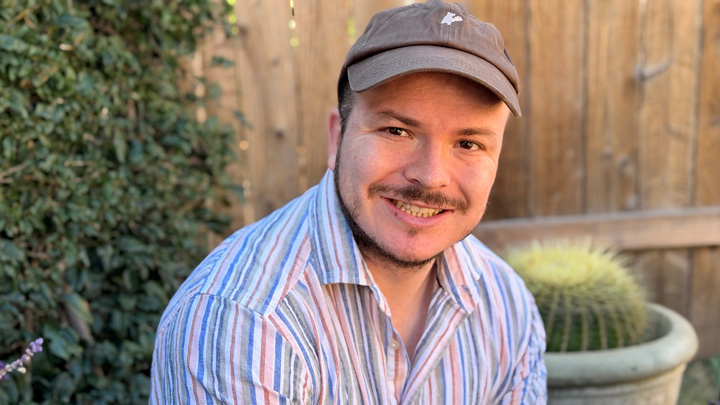
As a dual immersion social science teacher, David O’Leary always gets a kick out of the first day of class. Every year, he watches as his Spanish-speaking students walk in and register their surprise.
“It’s the best experience,” said O’Leary, who teaches at Edgewood Middle School in West Covina, California. “They see it’s Mr. O’Leary and they see that I am of fair skin, as well. But then they hear my Spanish and they’re like, 'Yep, this is the right classroom.’”
While O’Leary might not fit everyone’s superficial expectations of a bilingual educator, the Spanish-speaking population is quite diverse — and his passion for teaching multilingual learners is deep and extremely personal. It’s a big part of what inspired him to seek his masters degree from San Diego State University in dual language and English learner education.
O’Leary grew up in Oxnard the son of a bilingual migrant educator. In addition to teaching in Ventura County’s vibrant farmworker community, Denis O’Leary was an activist who had been a regional president of the California Association of Bilingual Education (CABE) and proudly marched with iconic civil rights leader Dolores Huerta and the United Farm Workers (UFW).
It’s a legacy David O’Leary takes very seriously.
“I want to continue his work and improve on it,” he said “I want to work with others to help out English language learners and those with multilingual backgrounds.”
Lived experience
What Mr. O’Leary’s kiddos don’t know, but quickly discover, is that their teacher was once labeled an English language learner himself. It’s something of a long story — one that spans continents.
Denis O’Leary met David’s mother, Viviana Doty, while studying abroad in Chile. The two kept in touch by writing each other letters and, several years later, Denis returned to South America to propose. After David was born, he was raised as a native speaker of Spanish by his mother, who exclusively spoke to him in the language at home.
All was well until David went to kindergarten and was placed in an English immersion classroom.
“Throughout the year, I wasn’t able to participate well with other students in the classroom because there was a big language barrier,” he recalls. “My kindergarten teacher recommended I repeat the grade level because, appropriately, he could not assess me.”
His parents intervened and got David placed into a bilingual Spanish-speaking first grade classroom where he started slowly mastering English while also keeping up to speed on his other coursework. But in third grade, he bumped up against a political barrier.
California passed Proposition 227 in 1998, effectively banning bilingual education. The law remained in place until it was repealed by voters in 2016.
For O’Leary, Prop 227 meant being sent back to an English immersion only classroom. Because he wasn’t yet fluent in English, he started falling behind again in his grade level. At the same time, he started to lose his fluency in Spanish.
It was a difficult experience that informs the educator he is today.
“Early on, I got first-hand experience of how it is as a student to be in a learning environment that doesn’t embrace your culture — that doesn’t embrace your entire language skill set,” O’Leary said. “Not being able to use your strengths to build other strengths detracts from your overall learning.
“As an educator, I want to be in a position where I embrace multilingualism. I embrace students who speak other languages and I ensure that they feel welcome, that they feel included in the environment and that they can collaborate with their classmates of different cultural backgrounds to form a community of learners.”
Education and advocacy
Now in his first year of his master’s program at SDSU, O’Leary is eager to learn more about dual immersion in secondary education and how the education system can better support multilingual learners.
Encouraged by program coordinator and advisor Tamara Collins-Parks, he’s also taking on advocacy work as his father once did. In October, O’Leary was elected as the California Teachers of English to Speakers of Other Languages (CATESOL) Assistant Interest Group Chair for 2026 and Lead Chair for 2027.
“Honestly it’s been fantastic,” he said of his graduate school experience. “The professors are very knowledgeable and the classroom setup really allows us to participate in a collaborative community experience.
“We get to really talk about what works, what doesn’t work and what we need to do as advocates to ensure that students receive the best education they can in multilingual learning.”