COE Connections Episode 18: Tanya Gaxiola Serrano
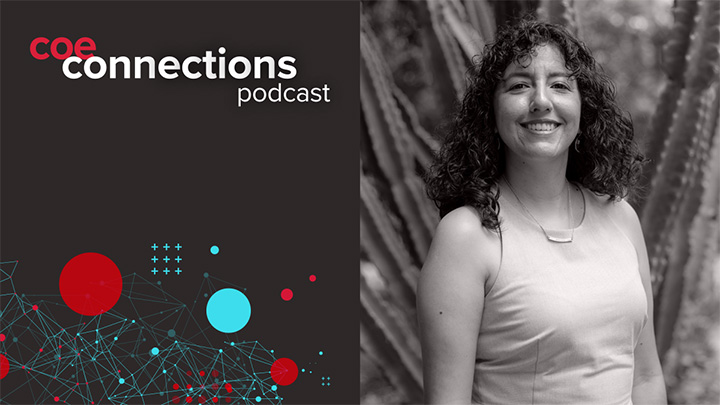
In the fifth episode of Season 3, Tanya Gaxiola Serrano, associate professor in the Department of Administration, Rehabilitation and Postsecondary Education, discusses her research on the experiences of communities of color in education.
Listen on Soundcloud and Apple Podcasts.
Tanya Gaxiola Serrano
My work has really served as an invitation gor communities of color, for women, for queer folks to be researchers. So, to first of all, see themselves as researchers, see themselves as knowledge producers in a way that doesn't strip away their humanity from them. So, thinking about ways that they can be their authentic selves. They don't have to police themselves, they can speak the language of their home. They can talk about their experiences, they don't have to be objective in ways that we've been taught to be, right? And instead, they can bring their whole selves to the research table, and invite others to be a part of that conversation as well.
(Music plays)
Rachel Haine-Schlagel
Welcome to COE Connections, the SDSU College of Education Research and Scholarship podcast series. I'm your host, Rachel Haine-Schlagel. I'm the Associate Dean for Research for the College of Education and a Professor of Child and Family Development at San Diego State University, a proud Hispanic-serving institution on the land of the Kumeyaay.
Today, I am joined by Dr. Tanya Gaxiola Serrano, whose pronouns are she, her, Ella. Tanya is an associate professor in the Department of Administration, Rehabilitation, and Postsecondary Education at SDSU. Tanya is a queer, first-generation Latina immigrant from the Tijuana-San Diego borderlands. Her research explores the racialized and gendered experiences of communities of color when navigating education in the U.S.-Mexico border to expose the functions of oppression.
As part of her commitment to disrupting dominant approaches to research and knowledge production, her work also focuses on developing research methodologies rooted in Chicana Latina feminista and critical race approaches that affirm and center the humanity of women and people of color. She is also a daughter, sister, wife, and mother to people that keep her grounded and remind her of the joy found in communities. Tanya earned her PhD from the University of California, Los Angeles Graduate School of Education and Information Studies, with a specialization in race and ethnic studies.
Welcome, Tanya, and thank you so much for taking the time to talk with me today.
Tanya Gaxiola Serrano
Thank you so much, Rachel, for the invitation, and I'm looking forward to having a chat.
Rachel Haine-Schlagel
Yeah, I'm really excited. Okay, let's get started. My first question is, why do you study what you do?
Tanya Gaxiola Serrano
So, in thinking about that question I need to start with me, right? With who I am, and how that drives my interest and my research. So, to introduce myself a little bit more, I am from the Tijuana San Diego borderlands, which means that I am an immigrant, and that has definitely shaped how I experience the world and how I see the world.
I also identify as queer, as a Latina, first-gen college student, so all those things provide different lenses for me to understand communities like those that I belong and am from but also to think about what it is that I feel my call is, and what it is that I want to contribute to in my role as faculty, and also in my role as researcher.
To add a little bit more about me, I grew up specifically in Tijuana for the first 10 years of my life, so my life has been influenced by the border, right? That has been essential and critical. And then I immigrated at the age of 10 to Chula Vista, which is only a couple miles away from where I grew up in Tijuana. And Chula Vista, for those of you that might not know, is a predominantly Brown, Latinx immigrant Spanish-speaking community. And so, in a way, Chula Vista and Tijuana can feel very similar, but at the same time, very different. And being an immigrant myself, I knew that there was different expectations of me in these different places.
And when thinking about schools, there was definitely some fears that I had being exposed to a new system, a new way of learning a new language, but I think all that was further highlighted when I went to college. I went to UCLA as an undergrad, and that's where I experienced a lot more of that, like, culture shock, per se. Because I was in a place where the folks surrounding me were no longer brown, Latinx immigrants, Spanish-speaking folks, but they were, you know, affluent people from all over the state, the country, the world, you know, predominantly English speakers. White, and just with different forms of knowing that really made me feel intimidated and small in many ways, and so that's when I developed a lot of questions about my ability to succeed that I didn't quite have before, or not to that degree.
I share that because that has influenced my research agenda, right? Specifically, as part of the work that I do, I study the experiences of communities of color, the experiences of Chicanas, of Chicanos, Latine, Latinx folks, of people that grew up or navigate the U.S.-Mexico border. And then those that are navigating educational institutions, whether as students, as faculty. And a part of my work, not only am I trying to amplify those stories and highlight their struggles, their opportunities, their joy, their pain. But also think about the bigger picture of disrupting the ways of knowing that are rooted in white supremacy as we think about research methods and research methodologies.
It brings me a lot of joy to be able to do this, to think about how do we reimagine the research process, the data collection process, the methodologies that guide our work, our commitments. And how we show up as researchers, but also what it is that we seek to do with the stories, at least for me as a qualitative methodologist. That we collect, and how do we represent those in ways that honor our communities, in ways that are respectful. In ways that see their assets, and in ways that challenge the dominant stock story of communities of color, as folks that are, you know, in a culture of poverty, as folks that are unfit for schools, just a lot of deficit ideologies. That's what I seek to do with my work, and how my experiences have informed that.
And I also want to take the opportunity to say that you know, I didn't come to my research agenda or to my work, it didn't come easy to me. There was a lot of reflection that had to happen to get to that point, and a lot of encouragement and validation and affirmation from people that love me and care for me, right? Whether that's my mom not questioning my ability to continue with school, and really supporting and encouraging that. And also, my mom is an educator herself. She worked for 30 years in Tijuana. But also folks that I came to meet and work during my higher education trajectory, such as my mentor, Dr. Danny Solorzano, who's faculty at UCLA, that always pushed me to go back to my roots, to go back to my passion and to develop a research study or a research agenda that is not necessarily meeting the needs of other folks, or that is not driven by funding opportunities, or by hot topics that might be sexy, you know, at that point in time, but by work that really fills me, fills my cup, fills my joy, right, fills my heart.
And I didn't think I could do that. And just having someone with his status really open that door and say, like, go back to who you are and do that work, because you're the right person to do that work, has just been life-changing for me, and that's also what I hope to do. In my research, but also, you know, for the folks that read my work, or with my students, with my doctoral advisees, is do work that matters to you, que vale la pena, which is a very popular quote from Gloria Ansaldua, who's a Chicana feminist queer scholar that has now, passed on.
Rachel Haine-Schlagel
There's so many things in what you just shared that I would want to comment on. I think one thing that I'll just say is that after reading some of your work in preparation for our conversation today, I was really struck by the, the impact that your work is having on disrupting the objectivity of white-dominated methods. And, you know, I've been… I teach research methods in my program, and I'm definitely going to be using one of your papers in my… in my course moving forward, just because it was a really powerful example.
And the other thing I just need to say that's really cool, and you might mention this more later, is that you are the second faculty member that we've had on this podcast who has published with their mother, and I just think that is phenomenal, and a great example of subjective research, right? You know, your mom is not a academic, and you guys have worked together on your research. So I… but I could keep going, but I'm gonna stop.
Let me ask you now, what are you working on? Like, what are you working on right now?
Tanya Gaxiola Serrano
So right now, I think I have a couple really cool projects that I'm very passionate about, and part of that is because they're in collaboration with graduate students, folks that just reached out to me and said, hey, can I jump on a project with you? And that was, you know, I think a great opportunity to build community and provide mentorship, but also to think about what are the issues that are impacting us at the moment. So one of the studies that I'm working on, and we just submitted IRB, which is, you know, something that we're excited about, is thinking about how currently in this social-political climate that is highly impacting higher education, right, with a lot of anti-DEI narratives and discourse, and practices and funding attached to it as well, thinking about how is that causing harm, particularly racial harm for student affairs practitioners, specifically those that are entry level, that are just getting into higher education and trying to serve our students as student affairs professionals, but how are they navigating the impact of that the racist, transphobic, xenophobic policies, and then turning around and serving students with those same identities.
You know, the focus would be to understand how racial harm is taking a toll on the student affairs professionals of color, but also how does it manifest on our body, on our mind, and on our spirit? And that's a Chicana feminist concept by Dr. Irene Lara, who's here at San Diego State in the Women and Gender Studies Department. And it really talks about how we carry a lot of this emotional burden, a lot of this, you know, racism, sexism that's placed in our bodies, and it manifests, whether that's in, like, sleep deprivation or sense of doubt about our future in the field, emotional taxation, etc. So, really taking this opportunity to center the manifestation of harm on student affairs professionals of color. And so that's… that's one project that I have going on.
The other one is on racial microaffirmations, which is… I think we've been studying racial microaggressions for some time, which is a critical race theory concept, and now we're moving to racial microaffirmations in collaboration with Dr. Danny Solorzano. To think about what are the practices that affirm and validate students of color? And these are pedagogical practices, curricular practices, that allow students to feel seen. And to feel humanized, validated. And so, we're doing a case study of Chicana, Chicano, Chicanx studies courses at San Diego City College. So what does it mean for these students of color to be in classrooms that are engaging in racially microaffirmative practices that allow their full humanity to be nurtured and taken care of in particular classroom spaces. And how can that help protect us, or help us heal from the harm that a lot of these students have encountered throughout their educational trajectory?
Rachel Haine-Schlagel
Those both sound so cool, especially the… I love the, shift from aggression to affirmation, and the idea that, you know, moving beyond, sort of, for people who are inflicting harm, from noticing what they're doing, which has been the work of a lot of microaggression work, I think, with faculty and people in positions of privilege.But to move on from there and go to, like, well, what should… what should we do different? What can we do different that's gonna not just sort of avoid inflicting harm, but actually promote health and joy. So, that's… love that.
Okay, can you please describe an example of the impact that your research has had on the community? And you can define community however you like.
Tanya Gaxiola Serrano
I love that question, because it's an opportunity for me to reflect on the intentionality, or the intentions behind my work, and how am I measuring… measuring is probably not the best word, but it's the word that's coming to me right now. How am I measuring the impact of my work? And so, when I think of that, I'm thinking about how my work has really served as an invitation for communities of color, for women, for queer folks, to be researchers. So, to first of all, see themselves as researchers, see themselves as knowledge producers in a way that doesn't strip away their humanity from them.
So, thinking about ways that they can be their authentic selves. They don't have to police themselves, they can speak the language of their home, they can talk about their experiences, they don't have to be objective in ways that we've been taught to be, right? And instead, they can bring their whole selves to the research table, and invite others to be a part of that conversation as well. And I think that's one of the biggest impacts that my work has had, and I say that because I've received notes, emails, conversations from students and colleagues that tell me, I never thought research could be done this way. Or I'm no longer afraid to be in this research class. Or I'm excited. I didn't know that there was Black methodologies, that there was, like, feminist methodologies. I always thought it had to be objective, and I'm no longer afraid. And when I get that sort of feedback or comments.
In such a joyful place, and it's so validating, because it affirms that we need to continue with this work, we need to continue having these conversations. Even when they feel difficult at times, because we are working against very large systems that have been foundational to the way that we do things in higher education and in research. But those small moments. Those conversations, those emails, those notes, just light a fire in me to keep going, and to keep sharing this work, to continue publishing it, and to continuerethinking and reimagining research methods and methodologies. So, to be a little bit more specific, I have developed, alongside a lot of really good colleagues, friends, and mentors. Different Chicana-Latina feminista methodologies that ask us to center our own knowledge production, center our brown bodies, center our moms, our folks in our homes, as ways of knowing. And specifically, we've published work around feminista platicas, feminista walking platicas, and it challenges that notion of keeping research sterile and clean and objective.
And it's saying, hey, if you're gonna ask a participant or a collaborator to answer a question, you need to ensure that you're ready to answer that question yourself. So thinking about vulnerability and reciprocity, trust. It's also asking us to be aware that in order for us to let go of some of the power that's inherently found in research processes, that we need to be okay with participants letting us know what it is that they want to share.
In other words, sometimes we might feel like they're not answering the protocol question, but that is what this participant is theorizing as their knowledge, and what they want to share with us, and we need to be respectful of that. Some of the benefits of engaging in this type of work in ways that are culturally aligned or affirming is that it can be healing at times for you to be able to sit down with someone that looks like you, that understands your experiences, that understands your language.
And to be validated, right? To have a space to share something that is maybe intimate, or painful, or joyful can be heartwarming, can be healing. Can provide a sense of the sauvo, desogarse, Relief. And I've had that feedback from participants when engaging in data collection. People get emotional when talking about some of the things that I ask in our platicas. And again, I have to also put myself in their shoes and be willing to share things that are personal, too, and build community. And then, you know, I get that feedback of, like, thank you for giving me the space to share this. I feel seen, I feel heard, and I look forward to seeing what you do with this. And that, again, is similar to what I was saying earlier, it's just validating to know that I'm doing research in a way that's giving something back, as small as it is in that moment, to have the space to feel heard and listened to and cared for, instead of the more traditional approaches that are so extractive and not really caring for the individual that's sitting in front of you in ways that are more holistic and more humanizing.
Rachel Haine-Schlagel
I love what you said about, you know, be prepared to answer all the questions that you ask. I think that is a really powerful kind of mantra for all of us who train new researchers. To be thinking about communicating, you know, that if you're going to be asking a lot of personal questions of someone else, that you need to be able to have answered them in front of that group of people as well. And be just as vulnerable. This is so different from how I was trained, and
I'm so appreciative of just the work that you're doing to really turn our sort of standard way of doing things on its head, because it's been perpetrating so much harm for so long.
Tanya Gaxiola Serrano
You know, part of the… of the work on, like, research methods and methodologies, it's really asking us to think about, like, an epistemic shift, right? Like, thinking about who have you traditionally thought produces knowledge? Who do you traditionally read? Who do you traditionally cite? And why is that? I know for myself, that was part of the unlearning that I had to do in terms of, yeah, why am I citing… white cis male folks, and it's probably because those were the main readings that I was exposed to as an undergrad or grad student, and to a degree, I continue to do and perpetuate that, right? Until, again, I was welcomed into the idea of, like, looking at other ways of knowing by other scholars, by men, by queer folks, etc. But part of that epistemic shift was what allowed me to look back at the folks in my own community, literally in my own home, meaning my mom.
And so my mom, as I mentioned earlier, was a kindergarten teacher and principal for 30 years in Tijuana, in the public school system. And so she has a lot of knowledge about working with families, working with youth, running a school, leadership. But the other part was that she was also a transnational worker, in the sense that we lived here in Chula Vista. And she would commute every day to Tijuana to go to work. And that's not a common story that we hear about, but it is a common practice, particularly for folks that have degrees that can continue to practice those degrees in their home country, and us being in the border, that just is a lot more feasible. You are not near the border.
But for her, and the reason why we co-wrote the article that we did on border epistemologies and mother-daughter pedagogies, was thinking about her desire to feel seen and to feel validated. And to continue to do the work that was meaningful to her. And so, even when that meant having longer hours because of the commute between two countries or when it mean that her salary was lower because of the peso-U.S. dollar exchange rate is constantly fluctuating, and it's not in favor of the pesos, she still decided to do that. And I think that was a way for her to resist the some of the epistemological violence that happens when you are an immigrant, when you are a woman, when you're not a native English speaker, particularly for my mom, who was an adult when she immigrated to the United States, and also for me to, again, challenge myself as to who gets to produce knowledge? And whose knowledge gets to be a part of academia. And there's a lot of pedagogies, right? There's a lot of teaching and learning that happens in our own households between our own parents, and I really wanted to highlight that, highlight how my mom has influenced me, how I have influenced her, and how that continues to shape both of our careers as educators, her, you know, in the… in the K-12 system for 30 years in Mexico, and me as a professor in the United States. Both of us immigrant, both of us women, both of us Mexicanas, right?
So I think that's part of that epistemic shift, looking inward and looking at, who am I not talking to that I should be? And documenting that, so that it's there, so that somebody else can read it, can cite it, and feel welcome to do similar work.
Rachel Haine-Schlagel
What do you struggle with the most in studying what you study?
Tanya Gaxiola Serrano
So, in thinking of this question, I think about the fast nature of academia, and what I mean by that is this constant push to produce more. Right? To publish more rapidly, to publish in specific types of journals, to do solo-authored pieces. That's just not the way my work works. Or how I want it to work. So I think that's a big sense of struggle for me, and tension, because… I do want to produce, but I want to produce in ways that are aligned with my epistemology, with my values, with my commitments, and that really honor the methodologies that I say I'm doing, right?
And the methodologies that I'm employing have a lot of care embedded in them. And so, therefore, relationship building is so important. As I mentioned, I'm doing a study with Chicana, Chicano, Chicanic studies at City College, and just the relationship building, right, has taken quite a long time, and I know that it's going to take longer for them to be able to trust me, trust me with their students, trust me with this research project. And that's okay, because I want this work to be meaningful for all parties involved. And to be authentic, and to represent the needs, not just my research interests and needs, but also their research interests and needs.
But again, that is not necessarily something that I can put in a CV, or that is, valued in academia. So I struggle with that, but thankfully, I've been able to publish and do work that matters to me, and I think I'm gonna continue to do that. But there's always that tension and that resistance of, like, am I not doing enough? But then, again. According to whom, right? Am I not doing enough?
Rachel Haine-Schlagel
Yeah, and I think that's a tension for a lot of our colleagues that are in our college, in particular, that are very focused on relationship-based work, and work that's in partnership with community, that it takes so much longer than, you know, sending out a national survey. Or even research beyond social and educational sciences. So, I can completely relate to your perception, I think, experience, and I think a lot of us can.
Tanya Gaxiola Serrano
I just want to say one more thing. This work is very emotionally taxing. It is so personal. It is so political. And that could mean that I am built exhausted, right? Like, my heart, my body, my mind, my spirit carries all that, because, again, it's… something that I really care about, but it's also something that is still impacting our communities today. So, I just want to put it out there, because I know that a lot of folks find themselves in the same position that I do, particularly women of color, queer folks, folks from communities of color, where they're doing work that's really, really important to them.
But unfortunately, it does come at a cost, because we're struggling, we're fighting against a system that might not value what we value. We're fighting against funding structures, against belief systems, publication protocols and standards, but also just keeping in mind our collaborators and participants. And that, while it keeps me grounded, it's also very intense. In many different ways, because I carry that with me.
Rachel Haine-Schlagel
It just sounds like you care so tremendously about every part of the research process, not just the results, but the entire process, and all of your participants, and yourself, and your family. I… I understand what you're saying. I can imagine that exacting a very high cost on a daily basis. I want to ask one more question, and that is, what would society look like if your work was done? Like, if there was nothing else for you to do, what would… what would things look like? Where you could be like, okay, I can retire and just hang out with my family and…
Tanya Gaxiola Serrano
Wow, I mean, I want to do that. I want to retire and go to Monarca to get Mexican chocolate ice cream on Adams Avenue. Shout out to them. But… I think my work is rooted on struggle. And so, if we were to address the fact that we have educational disparities, that we have, educational pipeline issues, deficit ideologies, you know, in K-12 and higher education. Then, yeah, my work would be done at that point, because that would mean that people like myself, immigrants, women, folks with disabilities, moms, etc. would have their humanity intact. They would be able to love themselves and see themselves in such a strong, beautiful light all throughout their lives. I want for that to happen, and that's part of the reasons why I do the work that I do, right?
I feel like being in front of the classroom, as a pedagogue, as a faculty, being a researcher, allows me to hopefully inform folks of some of the realities out there, and maybe that will shift something, even if it's just adding a little bit more information to their toolbox, right, about the disparities, about the impact of these disparities on them. I think that would be great, but… Yeah, I think that's what it would look like. It would look like we don't have, yeah, racist, sexist, transphobic ideologies and policies, the structure, what we can teach at elementary levels, what we can talk about and discuss in college classrooms. Yeah.
Rachel Haine-Schlagel
That sounds like a wonderful goal for all of us to work towards achieving, and hopefully someday we will get there. I also, just as you were speaking, just thinking about your focus on microaffirmations, and just thinking about how can we all work to affirm each other and ourselves more in our interactions, both professionally and personally. Maybe that would be a moment in which we aren't struggling anymore.
Tanya Gaxiola Serrano
Yeah, I agree, and I think that's what's exciting about that work on microaffirmations, that I also get to step aside from the struggle for a little bit, and find the joy, because there's also a lot of joy in our communities, and there's a lot of resistance and community building. And from a pedagogical standpoint, I want to find out what faculty are doing in their classroom that can help students see themselves in their full humanity and achieve their goals and not be harmed in that process.
Rachel Haine-Schlagel
Well, thank you, Tanya, so much for talking with me this afternoon. This was such a wonderful conversation. Thank you so much again.
Tanya Gaxiola Serrano
Yeah, thank you, Rachel, and honestly, this was a great opportunity for me to reflect on… on my wife, but also to think back about… on how much I've been able to accomplish, and maybe how much more I will be able to accomplish, and the meaning behind that work for the communities that I truly carry with me and that I care about. So, thank you for this opportunity.